
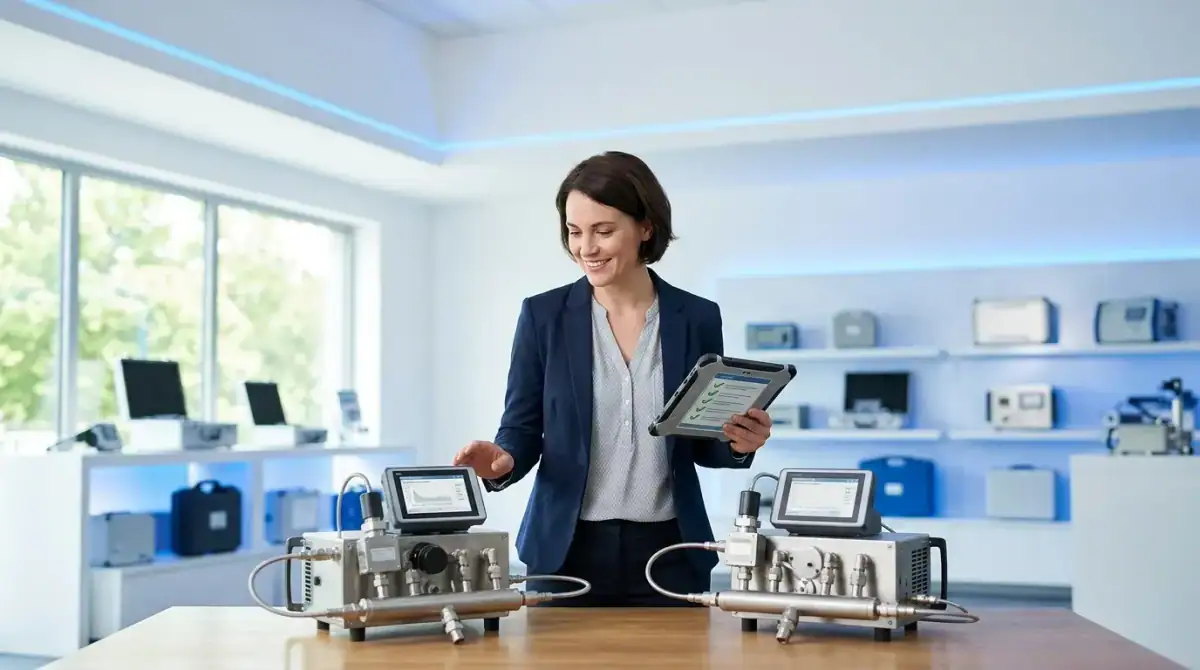
Buyer comparing two emissions measurement instruments, holding a tablet with a checklist

Guide

Buyer's Guide to Emissions Measuring Instrumentation

The 5 criteria to check before investing in an industrial emissions sampling or measuring instrument

Choosing an emissions sampling or measuring instrument is not just a matter of comparing datasheets: an inspection body, a laboratory or an industrial company must check documented standards compliance (verifiable, not merely displayed), robustness under real industrial conditions, the availability of after-sales service and spare parts, total cost of ownership and the technical support offered. This guide details these five criteria and provides a checklist of questions to ask any supplier before signing.

Key figures

  • Verifiable compliance, not just claimedCriterion no. 1
  • After-sales service and spare partsA criterion often overlooked
  • Purchase + calibration + consumables + downtimeReal cost

Why a Poor Choice of Instrument Is Costly

The purchase price of an emissions sampling or measuring instrument is only a fraction of what it will actually cost over its lifetime. A poorly chosen device first translates into a direct metrological risk: a poorly controlled isokinetic ratio, a probe unsuited to the duct's temperature or dust load, or a faulty sealing system can invalidate an entire campaign, with, as a result, a trip to be redone, a report that the client or the supervisory authority rejects, and a scheduling slip that ripples across the whole activity of an inspection body or laboratory.

Criterion 1: Verifiable Standards Compliance, Not Just Claimed

Every commercial datasheet for an emissions measuring instrument mentions reference standards: EN 13284-1 for dust, EN 1948 for dioxins and furans, EN 14385 for heavy metals, EN 13211 for mercury, ISO 9096, US EPA Method 5/17/23, VDI 2066, depending on the field. This mention is not enough: a professional buyer must be able to check concretely what the compliance claim covers, and by whom it was established.

Criterion 2: Robustness Under Real Operating Conditions

An emissions measuring instrument never operates in an air-conditioned laboratory: it is used on industrial ducts whose temperature can exceed several hundred degrees, in atmospheres laden with abrasive dust, acid compounds or condensable moisture, often outdoors and in all weathers, sometimes at hard-to-reach measurement points at height. The robustness of an instrument is therefore not judged on its nominal performance under ideal conditions, but on its documented endurance under the extreme conditions actually encountered in the target field.

Criterion 3: After-Sales Service and Parts Availability

An emissions sampling or measuring instrument is a production tool for an inspection body or a laboratory: each day of downtime translates directly into a postponed campaign, a client to be recontacted, or even an end client's regulatory deadline drawing closer. The availability of after-sales service and spare parts must therefore be assessed with the same seriousness as the instrument's metrological characteristics.

Criterion 4: Total Cost of Ownership

Comparing two instruments on purchase price alone frequently leads to a poor economic calculation. Total cost of ownership includes, at a minimum, the acquisition price, the cost and frequency of the periodic calibration operations required to maintain the instrument's metrological validity, the cost of specific consumables (filters, adsorbent resins, reagents, wear parts), the energy consumption of heated or motorised equipment used over long campaigns, and the indirect cost of downtime linked to maintenance or repairs.

Criterion 5: Technical Support and Training

The intrinsic quality of an instrument is not enough to guarantee reliable measurements if the operator using it is not properly trained in the device's specifics: setting the isokinetic flow rate, cleaning procedure between two samples to avoid any cross-contamination, precautions specific to the pollutant measured. A serious supplier offers initial training at delivery, adapted to the team's level of experience, and not merely a user manual.

Summary

Key takeaways

  • Does the certificate cover my exact use?

    Check that the standard cited, the measuring range and the application context of the certificate correspond precisely to the pollutant and the installation concerned, not just to the name of the standard.

  • Where can I check this certificate myself?

    Ask for the reference of the public register or the test report rather than settling for a mention on a commercial datasheet.

  • Has the instrument already worked under conditions comparable to mine?

    Ask for customer references in the same sector of activity (temperature, dust load, corrosive compounds) as the target site.

  • What is the average lead time for a common spare part?

    Distinguish the lead time for a standard wear part (seal, filter, heating element) from that for a specific part requiring manufacture.

  • Where is technical support located and how quickly does it respond?

    Technical support that is hard to reach in the middle of a field campaign translates directly into days of downtime.

  • What is the annual operating cost, beyond the purchase price?

    Ask for an indicative estimate of periodic calibration, routine consumables and preventive maintenance.

  • Can calibration be carried out on site or locally?

    Systematic return to the manufacturer for calibration greatly lengthens the instrument's unavailability.

  • What training is included at delivery, and for what level of experience?

    Check that the training covers procedures specific to the instrument (isokinetic conditions, anti-contamination cleaning) and not just general familiarisation.

Go further

Related standards

Frequently asked

FAQ

Questions about this topic? Here are the most common answers.

Another question?
Should purchase price or total cost of ownership take priority when choosing an instrument?+

Total cost of ownership is the relevant criterion: it includes the purchase price but also periodic calibration, consumables, maintenance and the cost of any downtime. An instrument that is slightly more expensive to buy can prove more economical over several years if its running costs are controlled and its after-sales service responsive.

Is a datasheet citing a standard enough to guarantee the instrument's compliance?+

No. The mention of a standard on a commercial datasheet has value only if it is backed by a verifiable document: a test report, a certificate issued by an accredited body, or, for automatic continuous measuring systems, an entry in a public certification register (EN 15267-3). It is recommended to systematically ask for this supporting document before purchase.

How can I assess an instrument's robustness before buying it?+

By checking the temperature ranges and resistance to corrosive effluents guaranteed by the manufacturer, and by asking for feedback from users operating in a sector of activity comparable to the target site (incineration, cement, metallurgy, etc.), whose thermal and particulate constraints differ significantly.

Why is spare parts availability a purchasing criterion in its own right?+

Because an instrument out of action for lack of an available part translates directly into a postponed measurement campaign, with an impact on the schedule of the inspection body or laboratory, and sometimes on the end client's regulatory deadline. The lead time for common parts and the responsiveness of technical support deserve to be checked before purchase, not after a breakdown.

What is the difference between a CEMS-certified instrument and a manual reference sampling instrument?+

EN 15267-3 type certification applies exclusively to automatic continuous measuring systems (CEMS/AMS). Manual sampling instruments (isokinetic probes, gas conditioning systems) do not fall under this certification: their compliance is assessed against the design and implementation described by the corresponding method standard (EN 13284-1, EN 1948, EN 14385, etc.), documented by test reports or feedback from an accredited laboratory.

Should I ask for customer references before buying an emissions measuring instrument?+

It is good practice: feedback from a user operating in a comparable sector gives a concrete indication of the instrument's real robustness and the actual responsiveness of after-sales service, complementing the contractual guarantees and the standards documentation provided by the manufacturer.

Is training in the use of the instrument really necessary if the team is experienced?+

Yes, because each instrument has its own specifics (isokinetic flow rate setting, cleaning procedure to avoid cross-contamination between two samples, precautions linked to the pollutant measured) that general experience on other devices does not necessarily cover. Training suited to the device reduces the risk of measurements being invalidated for an avoidable reason.

A project to scope? Our experts can help.

Personalised advice and a fast quote for your measurement project.