
Technician installing a long-duration dioxin sampling cartridge on an industrial chimney

Dioxins, furans & POPs

EN 1948: Determination of Dioxins and Furans (PCDD/PCDF)

Sampling and determination of dioxins, furans and dioxin-like PCBs in channelled emissions

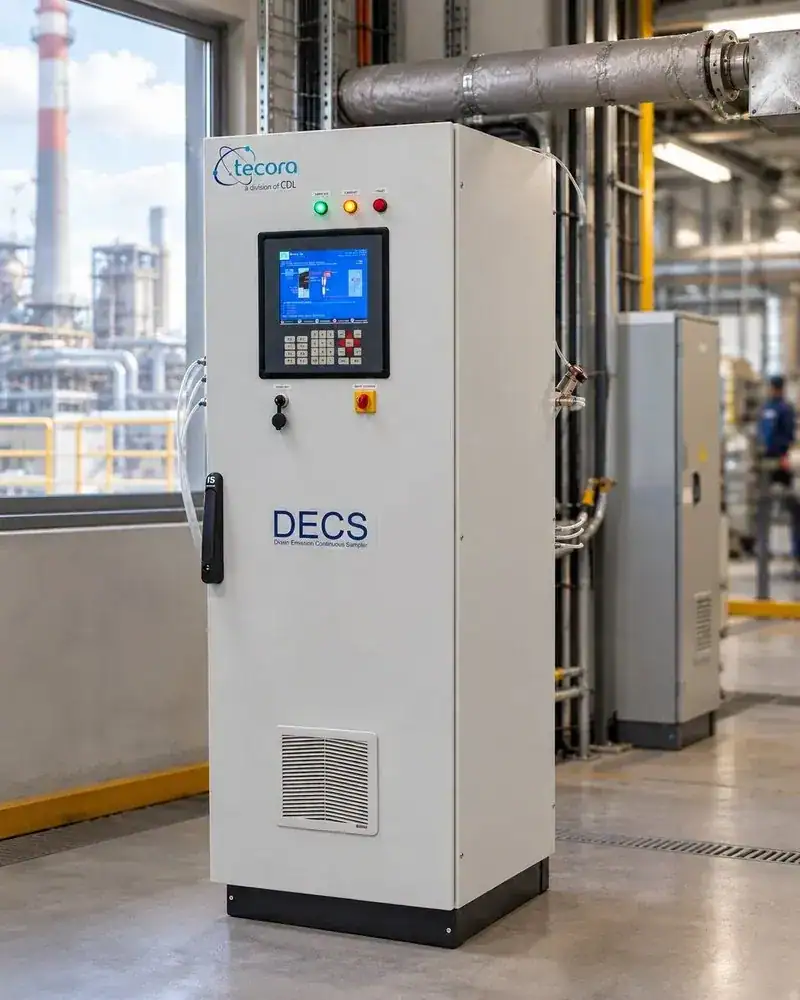
The EN 1948 standard is the European reference method for sampling (Part 1), extraction/clean-up (Part 2) and identification/quantification by chromatography (Part 3). It thus covers PCDD/PCDF (dioxins and furans) in channelled emissions from stationary sources. It applies in particular, for example, to waste-to-energy plants and to cement works co-incinerating alternative fuels. CDL-Tecora offers the DECS, a sampling system compliant with EN 1948 and USEPA Method 23.

Key figures

  • EN 1948-1/2/3Standard
  • GC-MSAnalysis
  • USEPA Method 23US equivalent
EN 1948 is divided into three complementary parts. Part 1 describes the sampling of PCDD/PCDF, and, in its most recent revision, of dioxin-like PCBs, directly in the emission duct. Part 2 then describes the extraction and clean-up of the sample taken before analysis. Part 3, finally, describes identification and quantification by gas chromatography coupled with mass spectrometry (GC-MS). This is the only recognised technique for distinguishing the 17 toxic congeners among the 210 possible forms of dioxins and furans.

Three-part standard

Sampling (EN 1948-1), extraction/clean-up (EN 1948-2), GC-MS identification/quantification (EN 1948-3)

Short-term or long-term sampling

Spot isokinetic probe (a few hours) or continuous adsorbent cartridge (several days to weeks)

Result expressed in TEQ

Weighted sum of the 17 toxic congeners according to WHO toxic equivalency factors

USEPA Method 23 equivalence

American method recognised as equivalent for sites operating under US EPA jurisdiction

On the ground

Points to watch

Choose the right sampling mode

A one-off regulatory check (short-term) may miss an emission peak caused by unstable combustion. Long-term sampling, on the other hand, gives a more representative picture over time, at the cost of a longer wait for results.

Avoid any cross-contamination of the sampling train

Dioxins are measured at trace levels (nanograms). Insufficient cleaning between two campaigns or an unsuitable probe material can therefore introduce a bias that invalidates the result.

Control the isokinetic ratio

As with dust measurement (EN 13284-1), non-isokinetic sampling over- or under-samples certain particle fractions. Since dioxins are partly adsorbed on particles, this skews the final result.

Use the correct toxic equivalency factors

The calculation of the final TEQ depends on the set of TEF factors used (WHO 2005 most often). An error or an obsolete reference can nevertheless change the value compared with the regulatory threshold, without the sampling itself being at fault.

Go further

Related standards

Frequently asked

FAQ

Questions about this standard? Here are the most common answers.

Another question?
What is the difference between EN 1948-1, -2 and -3?

Part 1 covers on-site sampling, Part 2 the extraction and clean-up of the sample in the laboratory. Part 3, finally, covers identification and quantification by chromatography/mass spectrometry (GC-MS). All three parts are needed to obtain a compliant result.

Should short-term or long-term sampling be preferred?

It depends on the objective. A one-off regulatory check generally uses short-term sampling (a few hours). Monitoring that is representative of the real variability of the process over several days or weeks, on the other hand, requires long-term sampling on an adsorbent cartridge.

What is TEQ and why are raw concentrations not compared directly?

Dioxins and furans comprise 17 congeners of very different toxicity. The TEQ (Toxic Equivalency) weights each congener by its WHO toxic equivalency factor before summing them into a single value comparable with the regulatory limit value. Comparing unweighted raw concentrations would therefore make no sense from a health standpoint.

Are EN 1948 and USEPA Method 23 interchangeable?

Both methods rely on similar principles (isokinetic sampling on an adsorbent medium, GC-MS analysis) and are widely recognised as equivalent. However, a site should check which one is explicitly required by its supervisory authority before choosing its protocol.

Does the DECS allow both short-term and long-term sampling?

Yes, depending on its configuration the DECS covers both sampling approaches described in EN 1948-1, in compliance with EN 1948 and USEPA Method 23.

Why does the isokinetic ratio also matter for dioxin measurement?

Part of the dioxins and furans present in flue gas is adsorbed on solid particles. Sampling that does not respect the isokinetic velocity of the gas stream samples these particles in a biased way. This therefore indirectly skews the dioxin determination result.

Preparing a measurement campaign? Our experts can help.

Personalised advice, a fast quote and technical support to choose the right instrument for this standard.