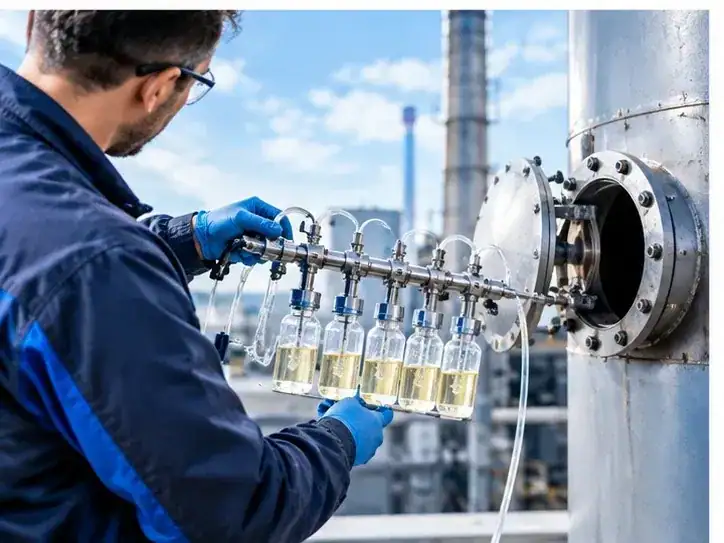
Technician holding a mercury sampling train with absorbing-solution bottles near a chimney

Mercury

EN 13211: Manual Determination of the Concentration of Total Mercury in Stationary Source Emissions

Manual reference method for sampling and determining total mercury in channelled emissions

EN 13211 (2001) is the European manual reference method for determining the concentration of total mercury in gaseous emissions from stationary sources (stacks, industrial ducts). The mercury is sampled isokinetically and trapped in a train of impingers containing an acidic absorbing solution, then determined in the laboratory, generally by cold vapour atomic absorption spectrometry (CVAAS). It is a spot measurement (a few hours) that gives total mercury (particulate and gaseous, all species combined), to be distinguished from continuous mercury monitoring, which is governed by a different technical specification (CEN/TS 17286).

Key figures

  • EN 13211:2001Standard
  • CVAASAnalysis
  • 0,001–0,5 mg/m³Measurable range
Mercury is a volatile, toxic heavy metal, persistent in the environment and bioaccumulative, and its industrial emissions are subject to strict limit values, in particular for waste incineration, co-incineration in cement works and certain combustion plants. EN 13211:2001, entitled "Air quality: Stationary source emissions: Manual method of determination of the concentration of total mercury", is the reference method used to verify compliance with these limit values during periodic regulatory inspections. It is validated for a precise scope: a total mercury concentration between 0.001 and 0.5 mg/m³, effluents whose total dust content remains between 0 and 20 mg/m³, and a gas temperature at the sampling point between 60 and 140 °C, conditions representative of emission ducts downstream of flue gas treatment.

Single manual method (no multiple parts)

EN 13211:2001 covers isokinetic sampling and the determination of total mercury in a single document, without being split into several parts like EN 1948 or EN 13284

Total mercury, all species combined

Trapping in an oxidising acidic absorbing solution (impingers) capturing both elemental mercury (Hg⁰) and oxidised forms (Hg²⁺), plus the particulate fraction retained on the filter

CVAAS analysis

Laboratory determination generally carried out by cold vapour atomic absorption spectrometry, a technique suited to the targeted concentration range (0.001 to 0.5 mg/m³)

Not to be confused with continuous monitoring

EN 13211 = regulatory spot measurement (a few hours); CEN/TS 17286 = continuous sampling system using sorbent traps for representative long-term monitoring

On the ground

Points to watch

Choose the right reference for your objective

A one-off regulatory check falls under EN 13211, whereas a continuous mercury monitoring obligation (increasingly common for waste incineration) falls under CEN/TS 17286: check which of the two references is explicitly required before choosing a protocol or equipment.

Control the isokinetic ratio

As with dust or dioxin measurement, sampling that does not respect the isokinetic velocity of the gas stream over- or under-samples the particulate fraction of the mercury, skewing the total result.

Avoid volatilisation of elemental mercury in the sampling train

Hg⁰ is volatile and can pass through a poorly configured or poorly temperature-controlled train without being trapped by the absorbing solution; the choice and renewal of the oxidising impinger solutions are decisive for the quality of the result.

Prevent any cross-contamination

Mercury is measured at trace levels: insufficient cleaning of the probe, filter or impingers between two campaigns can introduce a bias that invalidates the result, in either direction.

Observe storage conditions and time limits before analysis

The impinger solutions must be conditioned and transported in conditions that preserve their stability until laboratory analysis; an unsuitable delay or storage method can alter the result regardless of the quality of the on-site sampling.

Go further

Related standards

Frequently asked

FAQ

Questions about this standard? Here are the most common answers.

Another question?
What exactly does the EN 13211 standard measure?

EN 13211 measures the concentration of total mercury in the gaseous emissions of a stationary source, that is, the sum of the particulate mercury retained on the filter and the gaseous mercury (elemental and oxidised) trapped in an acidic absorbing solution, without distinguishing between chemical species.

What is the difference between EN 13211 and continuous mercury monitoring?

EN 13211 is a manual spot method: it gives a value representative of the sampling duration, typically a few hours, during a periodic regulatory inspection. Continuous mercury monitoring, governed by the technical specification CEN/TS 17286, uses sorbent traps sampling continuously to give a representative average value over much longer periods and to track the real variability of the process.

Which analysis technique is used after sampling under EN 13211?

The filter and impinger solutions recovered on site are prepared and then analysed in the laboratory, generally by cold vapour atomic absorption spectrometry (CVAAS), a technique sensitive enough to cover the concentration range targeted by the standard (0.001 to 0.5 mg/m³).

What types of site does EN 13211 apply to?

It applies to stationary sources subject to a mercury emission limit value, in particular waste incineration plants and cement works co-incinerating alternative fuels, as well as certain combustion plants, within the flue gas composition and temperature conditions for which the method is validated.

Does CDL-Tecora's MECS comply with EN 13211?

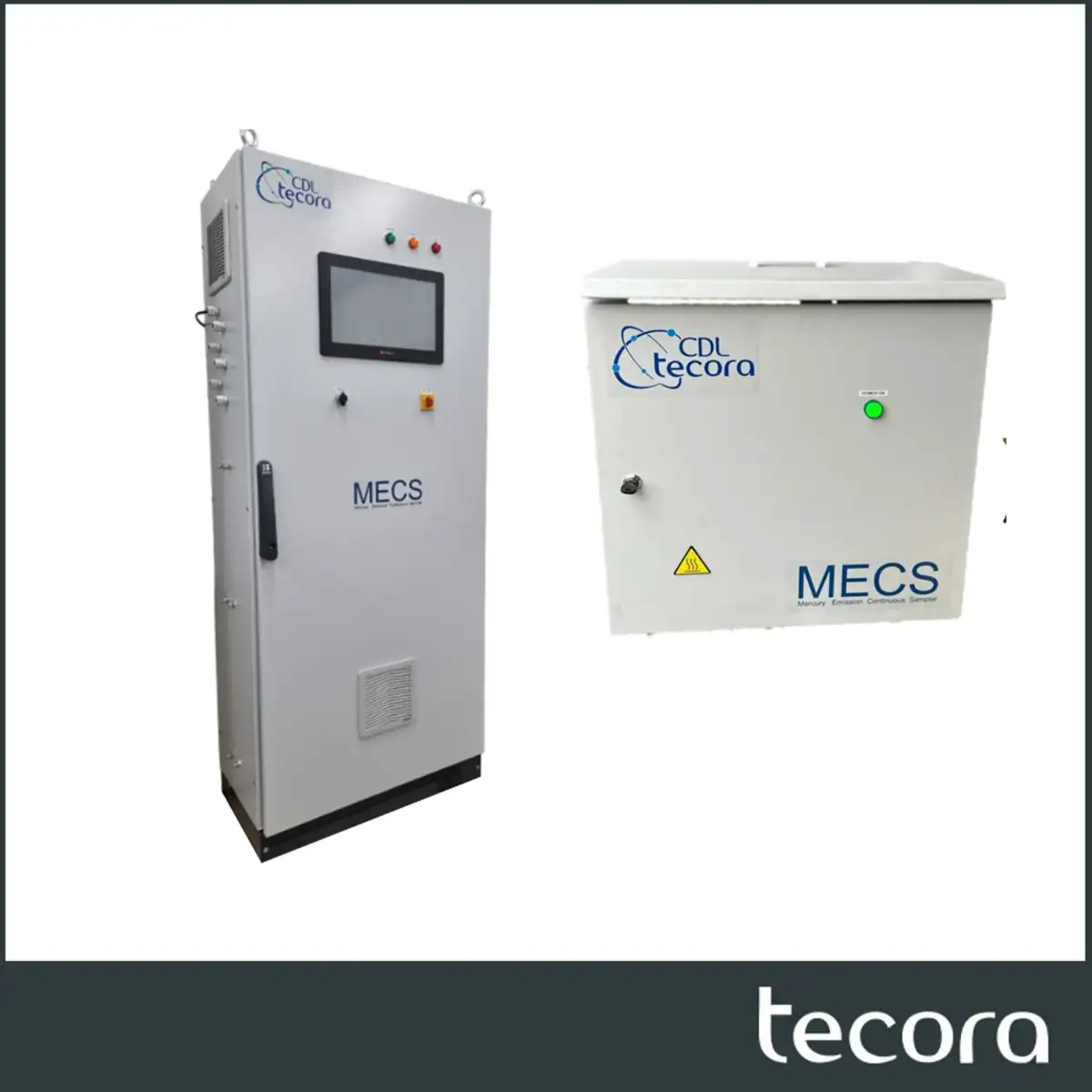
No, and it does not claim to: the MECS (Mercury Emission Continuous Sampler) is a continuous mercury sampling system compliant with CEN/TS 17286, a technical specification different from EN 13211. The two references meet distinct needs (spot regulatory check for EN 13211, representative continuous monitoring for CEN/TS 17286) and a site must check which one applies to it before choosing its equipment.

Why does controlling the isokinetic ratio also matter for mercury?

Part of the mercury present in flue gas is adsorbed on solid particles. Sampling that does not respect the isokinetic velocity of the gas stream samples this particulate fraction in a biased way, which indirectly skews the total mercury result, just as it does for dust or dioxins.

Preparing a measurement campaign? Our experts can help.

Personalised advice, a fast quote and technical support to choose the right instrument for this standard.