Why are dioxins and furans monitored?
Polychlorinated dibenzo-p-dioxins (PCDD) and polychlorinated dibenzofurans (PCDF), grouped under the common term "dioxins", form a family of 210 related chemical compounds that form unintentionally during incomplete combustion processes in the presence of chlorine: waste incineration, metallurgical processes, biomass combustion, certain industrial chemical processes. Unlike most industrial pollutants, dioxins are not manufactured intentionally for any commercial use: they arise as unwanted by-products.
Chemistry and Toxicology: Understanding the TEQ Concept
Of the 210 possible PCDD/PCDF congeners (75 dioxins and 135 furans, depending on the number and position of the chlorine atoms on the molecule), only 17 are considered toxicologically significant: those whose chlorine atoms occupy positions 2, 3, 7 and 8 of the molecular skeleton. The most toxic of them, 2,3,7,8-tetrachlorodibenzo-p-dioxin (2,3,7,8-TCDD, sometimes called "Seveso dioxin" in reference to the 1976 industrial accident in Italy that marked public opinion and accelerated regulatory awareness), serves as the reference for assessing the relative toxicity of the other 16.
Industrial Emission Sources Concerned
Waste-to-energy plants (WtE) remain historically the industrial source most closely associated with dioxins in the minds of the public and in regulations, because of the frequent presence of chlorinated compounds in household and industrial waste (PVC in particular) combined with combustion conditions that, if poorly controlled, favour de novo synthesis of dioxins during flue gas cooling between 200 and 450°C: a critical temperature range in which certain precursor compounds recombine in the presence of metal catalysts (copper in particular) present in fly ash.
The Standards Framework: EN 1948 in Detail
The European standard EN 1948 is the reference method for determining PCDD/PCDF (and, in its most recent revision, dioxin-like PCBs) in channelled emissions from stationary sources. It is divided into three complementary, inseparable parts: Part 1 describes on-site sampling, Part 2 the extraction and clean-up of the sample in the laboratory, and Part 3 identification and quantification by gas chromatography coupled with mass spectrometry (GC-MS): the only recognised technique able to individually separate and quantify the 17 toxic congeners with the required sensitivity and selectivity.
International Equivalents: USEPA Method 23
In the United States, the equivalent reference method is US EPA Method 23, codified in 40 CFR Part 60, Appendix A, which also determines PCDD/PCDF (and dioxin-like PCBs) using a sampling architecture very close to that described by EN 1948-1: heated probe, heated filter, condenser, XAD-2 resin module, then impinger train. A technical point of vigilance common to both methods is strict control of the temperature of the XAD-2 resin, which must remain below 50°C at all times throughout sampling: above that, the resin degrades thermally and the sample is invalidated, whatever the quality of the rest of the protocol.
Practical Implementation: Common Pitfalls and Best Practices
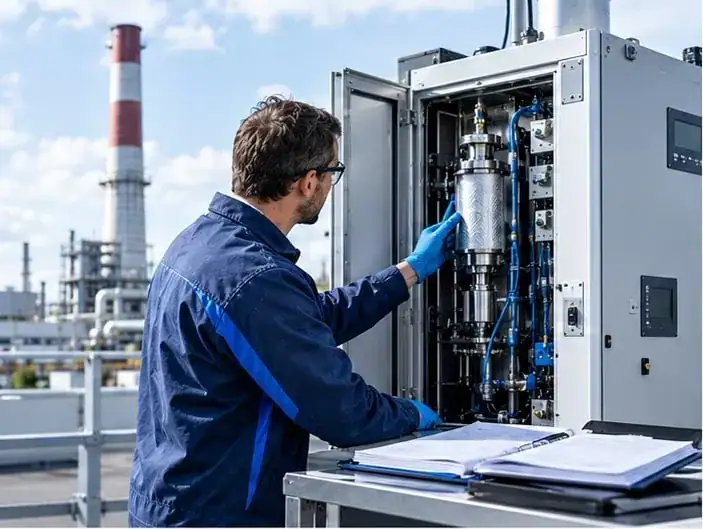
Cross-contamination remains the number one risk in a dioxin measurement campaign, precisely because the concentrations involved are measured at extreme trace levels (nanograms, even picograms). Insufficient cleaning of the probe between two campaigns, an unsuitable sampling-line material, or accidental contamination by a solvent or a material containing traces of chlorinated compounds can be enough to invalidate a result, in either direction: a false positive and a false negative alike having significant regulatory or financial consequences for the operator.
CDL-Tecora Instruments and Solutions
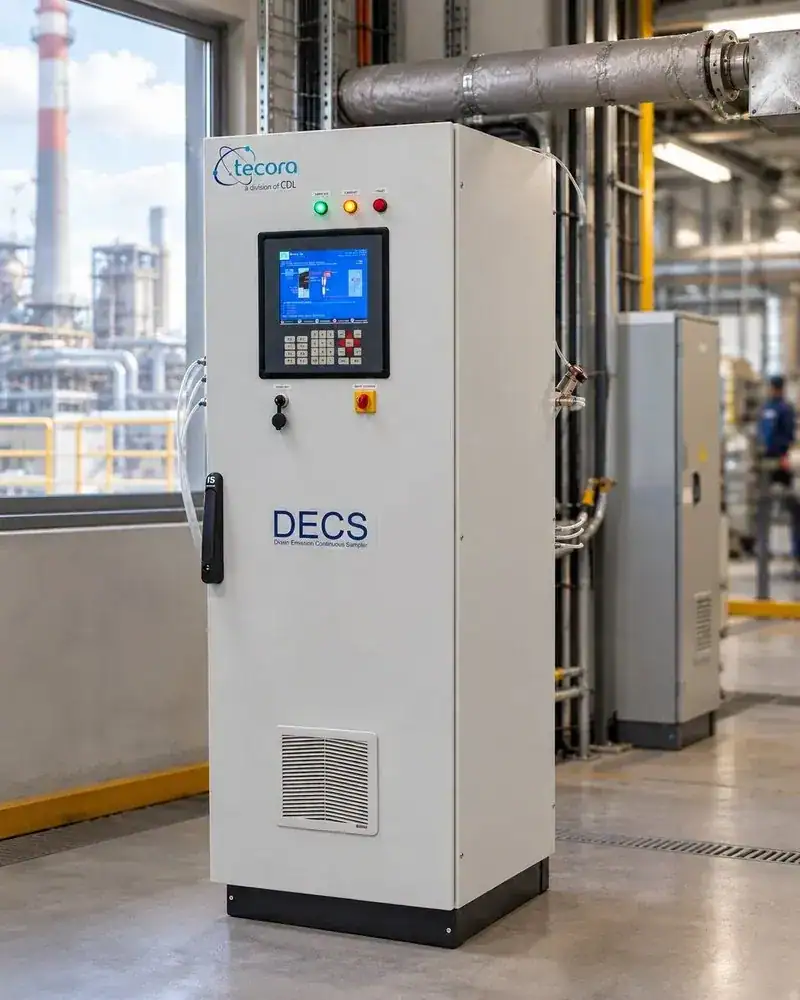
CDL-Tecora's DECS is the range's reference sampling system for dioxins, furans, PCBs and other persistent organic pollutants (POPs), designed to cover both short-term and long-term sampling depending on the configuration chosen, in compliance with EN 1948 and its American equivalent USEPA Method 23. This dual compliance makes it a relevant choice for laboratories and inspection bodies working for industrial groups operating under several regulatory jurisdictions, without having to qualify different equipment according to the reference required at each site.
Regulatory Outlook
The revision of the Industrial Emissions Directive (known as IED 2.0, Directive (EU) 2024/1785) strengthens several environmental monitoring requirements for large industrial installations, in a context where the European authorities are paying growing attention to persistent organic pollutants in the broad sense: dioxins and furans, but also, more recently, per- and polyfluoroalkyl substances (PFAS), which are the subject of a distinct regulatory dynamic that is comparable in its logic (environmental persistence, toxicity at low dose, difficulty of measurement at trace level).