
Environment, Hygiene and Health
Local Authorities & Air Monitoring Networks
AASQA and European Ambient Air Monitoring Networks
Approved air quality monitoring associations (AASQA) in France, and their equivalents in other Member States, continuously measure regulated ambient air pollutants (PM10/PM2.5, NO2, SO2, O3) under Directive 2008/50/EC, using reference methods harmonised at European level. CDL-Tecora supplies air quality and atmospheric hygiene measuring instruments suited to these networks, building on its know-how in industrial emissions monitoring.
Key facts
- Directive 2008/50/ECRegulatory framework
- Regional AASQAKey players in France
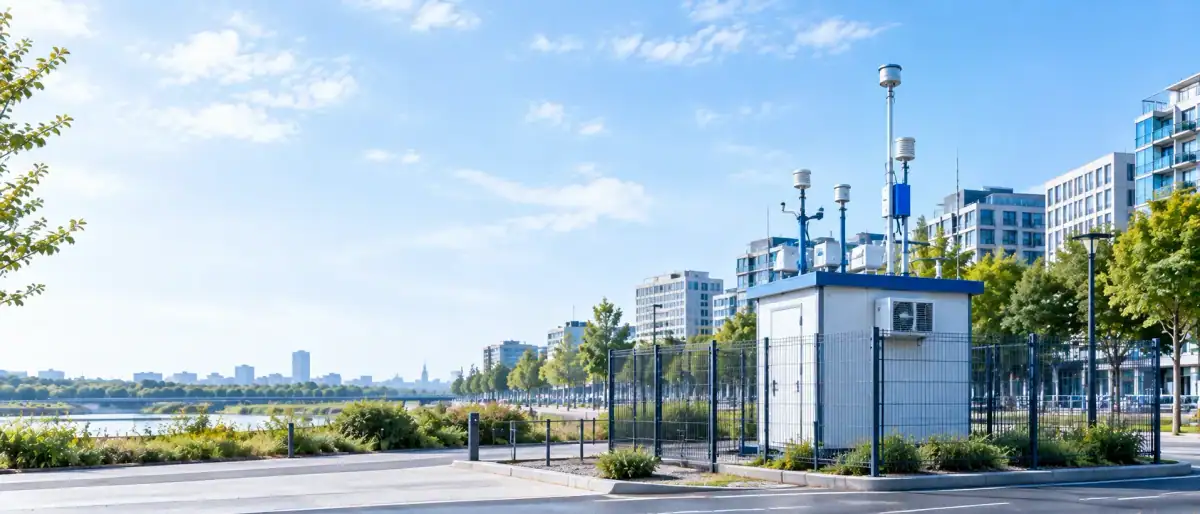
Network of fixed stations
Regional networks covering urban background, traffic, industrial and rural areas depending on the monitoring objective
Mobile campaigns
Spot measurements to document an area or a period not covered by the fixed network
Reference method and equivalent method
The EN 12341 gravimetric method is the reference for particulate matter; an automatic analyser must demonstrate its equivalence before being used in a network
Inter-station comparability
Harmonised reference methods (EN 12341, EN 14211, EN 14212, EN 14625) for data that are comparable from one network to another
Gradual extension of the regulated scope
PM2.5 has been added to the historical PM10, with its own thresholds and its own monitoring requirements
Sector challenges
Business challenges
Long-term reliability
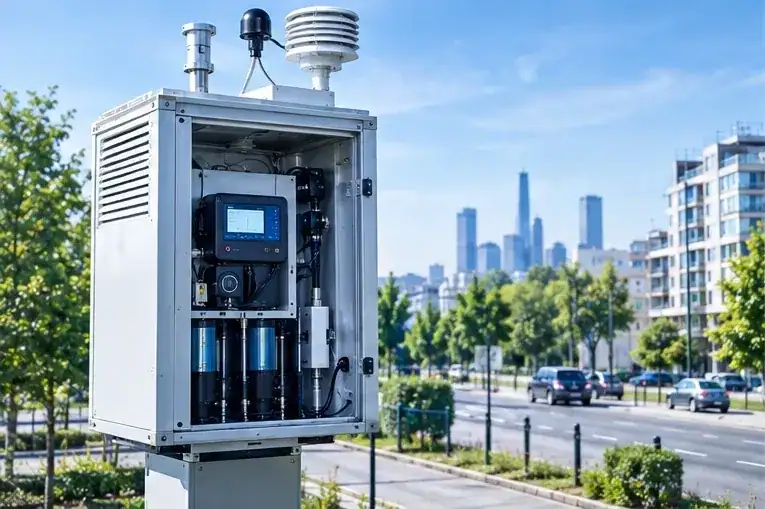
A measurement station operates continuously over several years, sometimes with no possible interruption: sensor drift must be detected through regular calibration and corrected before it durably skews a data series.
Inter-station and inter-network comparability
Reference methods harmonised at European level guarantee that the measurements produced by different stations and networks remain comparable with one another, a prerequisite for consolidated European reporting.
Coverage of diffuse areas
The fixed network cannot cover everything: mobile campaigns make it possible to document a specific area or period (new road, construction site, localised pollution episode) without multiplying permanent stations.
Demonstration of equivalence of automatic analysers
An automatic analyser, more practical to operate than a gravimetric sampler, can be deployed routinely only after demonstrating, by direct comparison with the reference method, that it produces results sufficiently close in the field.
Monitoring an additional parameter: PM2.5
Adding PM2.5 alongside the historical PM10 has extended the scope to be monitored, with its own data quality objectives and its own exposure thresholds, without easing the requirements already in place for PM10.
What we offer
Our solutions for this sector
The CDL-Tecora families most used in this sector — click to see all the instruments in the family.


Regulatory framework
Applicable standards and regulations
Directive 2008/50/EC
Ambient air quality and cleaner air for Europe
Gravimetric reference method for PM10/PM2.5 particulate matter
Reference method for nitrogen dioxide and nitrogen oxides
Reference method for sulphur dioxide
Reference method for measuring ozone by UV photometry
Reference method for measuring carbon monoxide by non-dispersive infrared spectrometry
FAQ
Have questions about this sector? Here are the most frequent answers.
Another question?What is an AASQA?
An Association Agréée de Surveillance de la Qualité de l'Air (approved air quality monitoring association), a French regional body responsible for continuously measuring ambient air quality under European Directive 2008/50/EC. Each AASQA manages its own network of stations and transmits its data to the national and European air quality reporting bodies.
How does ambient air monitoring differ from industrial emissions monitoring?
Ambient monitoring measures the quality of the air breathed by the population at a given point in the territory, whereas emissions monitoring measures discharges at the source of an industrial installation, generally at the stack outlet. The methods, regulatory thresholds and objectives (public health on one side, compliance of an installation on the other) differ accordingly.
What is the gravimetric reference method and why is it used for particulate matter?
It is the method standardised by EN 12341: a known volume of air is drawn onto a filter, weighed before and after exposure under controlled temperature and humidity conditions, the mass difference giving the particle concentration. It serves as the legal reference because it directly measures a mass, without depending on an indirect physical principle that could vary with the composition of the particles.
What is an equivalent method within the meaning of European regulations?
It is an automatic measurement method, different from the gravimetric reference method, whose results have been compared with those of the reference in parallel measurement campaigns in the field and judged sufficiently close to be used routinely in a network. It is this demonstration of equivalence, not the manufacturer's specifications alone, that authorises an automatic analyser to produce regulatory data.
Why was PM2.5 added to the regulations in addition to PM10?
European regulation was first built around PM10. PM2.5, the finest fraction of suspended particles, was introduced later as a separate parameter by Directive 2008/50/EC, with its own values, because the finest particles penetrate deeper into the respiratory system and present a specific health issue, not covered by PM10 monitoring alone.
How does an AASQA choose the location of its measurement stations?
The location depends on the station's objective: an urban background station documents the average exposure of the population in an urban area, a traffic station measures the direct impact of road traffic in the immediate vicinity of a road, and an industrial or suburban station targets the influence of a particular source or area. This choice directly conditions the interpretation of the data produced.
What is the role of a national technical body in the operation of the AASQA network?
In France, a national technical body coordinates the metrological aspects of the AASQA network: harmonisation of methods, qualification of instruments, support for equivalence demonstrations and for measurement traceability. This technical coordination role contributes to the consistency and comparability of the data produced by all the regional AASQAs.

A project in this sector? Our experts are ready to help.
Personalised advice, a fast quote and technical support to choose the solution suited to your challenge.