PFAS in Industrial Emissions: Emerging Regulation (2026)
Regulatory and technical watch on the monitoring of per- and polyfluoroalkyl substances (PFAS) in channelled emissions
Monitoring PFAS (per- and polyfluoroalkyl substances) in atmospheric emissions is a fast-moving regulatory topic: to date, no harmonised European or international sampling and analysis standard has been finalised. Several national frameworks are already converging towards concrete obligations: in France, the order of 31 October 2024 requires PFAS air measurement campaigns at waste incineration and co-incineration plants, based on the French experimental standard XP X 43-126. At European level, the revised IED directive (IED 2.0, transposition expected by 1 July 2026 at the latest) adds PFAS to the list of polluting substances in its Annex II for the first time, while a dedicated CEN working group has launched its standardisation work with no known publication timetable at this stage.
Key figures
XP X 43-126 (experimental)French standard
1 July 2026 (at the latest)IED 2.0 transposition
49 semi-volatile PFASCompounds targeted (France)
PFAS comprise several thousand fluorinated compounds, used notably as non-stick agents, waterproofing agents or surfactants, whose environmental persistence and potential toxicity have led to rapid regulatory movement on water, soil and, more recently, air. Unlike methods that have been stable for a long time, such as EN 1948 for dioxins and furans, PFAS measurement in channelled emissions has no harmonised European or international standard (ISO, CEN) to date: the current landscape consists of national texts, uncodified American methods and ongoing standardisation work, which must be clearly distinguished from one another so as not to over-interpret their scope.
No harmonised standard finalised
Neither the EU nor ISO/CEN has to date published a harmonised standard for sampling and analysing PFAS in air; the texts available are national (France), regional (Flanders) or uncodified American methods.
France ahead on regulation
The order of 31 October 2024 requires PFAS measurement campaigns at waste incineration and co-incineration plants, based on the experimental standard XP X 43-126.
IED 2.0 brings PFAS into its Annex II
Two PFAS entries added to the list of polluting substances of the revised Industrial Emissions Directive, transposition expected by 1 July 2026 at the latest.
European standardisation under way
A dedicated CEN/TC 264 working group has launched its work on the determination of PFAS in emissions and ambient air, with no known publication timetable.
On the ground
Points to watch
01
Properly qualify the status of the applicable standard
XP X 43-126 is an AFNOR experimental standard ("XP" status), that is, a provisional document tested before confirmation or revision, and should not be presented as a final approved standard or an international standard in a regulatory file.
02
Do not confuse sampling architecture with analysis method
A sampling train that is structurally similar to those used for POPs (dioxins/furans) does not guarantee equivalent trapping performance for PFAS: their extraction and quantification rely on polar chemistry (LC-MS/MS) distinct from the GC-MS chromatography used for dioxin congeners.
03
Control the risk of cross-contamination
PFAS are present in many common materials (PTFE, treated textiles, certain lubricants and seals); a sampling train not specifically verified as "PFAS-free" can introduce a positive bias: field blanks and method blanks are essential.
04
Follow the staggered regulatory timetable
French deadlines for the first measurement campaign vary according to the type of installation and the ICPE heading concerned (2770, 2771, 2971, 3520) and are spread over several years: check your specific case well in advance.
05
Distinguish measurement obligation from emission limit value
The addition of PFAS to Annex II of IED 2.0 paves the way for limit values at permit level, but does not at present set a single harmonised European threshold: this will be built up gradually through national transpositions and future BREF conclusions.
What we offer
Instruments compliant with this standard
CDL-Tecora product families most used to comply with this standard — click through to see every instrument in the family.
Is there a European or international standard for measuring PFAS in industrial emissions?
No, not to date. Neither ISO nor CEN has published a harmonised standard for sampling and analysing PFAS in air. CEN/TC 264 has launched a dedicated working group on the subject, but no publication deadline has been announced. The references currently available are national or regional (France, Flanders) or uncodified American methods.
What is the French standard XP X 43-126?
It is an AFNOR experimental standard published at the end of 2024, entitled "Stationary source emissions: Sampling and analysis of semi-volatile polar per- and polyfluoroalkyl substances (PFAS)". It covers 49 semi-volatile PFAS compounds, in gaseous and particulate form, and draws on the principles of the American method OTM-45. Its "experimental" status means it remains subject to testing in practice before any confirmation or revision.
What does the French order of 31 October 2024 require of incinerator operators?
It requires a PFAS measurement campaign in the channelled atmospheric emissions of incineration, co-incineration and other waste thermal treatment plants falling under ICPE headings 2770, 2771, 2971 and 3520, carried out by a laboratory accredited on the basis of standard XP X 43-126. First measurement deadlines are staggered according to the type of installation, between the end of 2025 and 2028.
What does the IED 2.0 directive change for PFAS?
The revised Industrial Emissions Directive (IED 2.0), to be transposed by Member States by 1 July 2026 at the latest, adds PFAS substances to the list of polluting substances in its Annex II. This paves the way for emission limit values set case by case in permits, as well as reporting of PFAS emissions via the future European industrial emissions portal, without fixing a single harmonised EU-wide threshold at present.
What is the American method OTM-45 and does it apply in Europe?
OTM-45 is a US EPA "Other Test Method", published in 2021 and revised in January 2025, which describes the sampling and analysis of PFAS in stationary source emissions. Its status is intermediate: recognised as representing current best practice, but not yet codified as a full US regulatory reference method. It does not apply directly in Europe, but it served as the technical basis for the French standard XP X 43-126.
Does CDL-Tecora's DECS comply with a PFAS measurement standard?
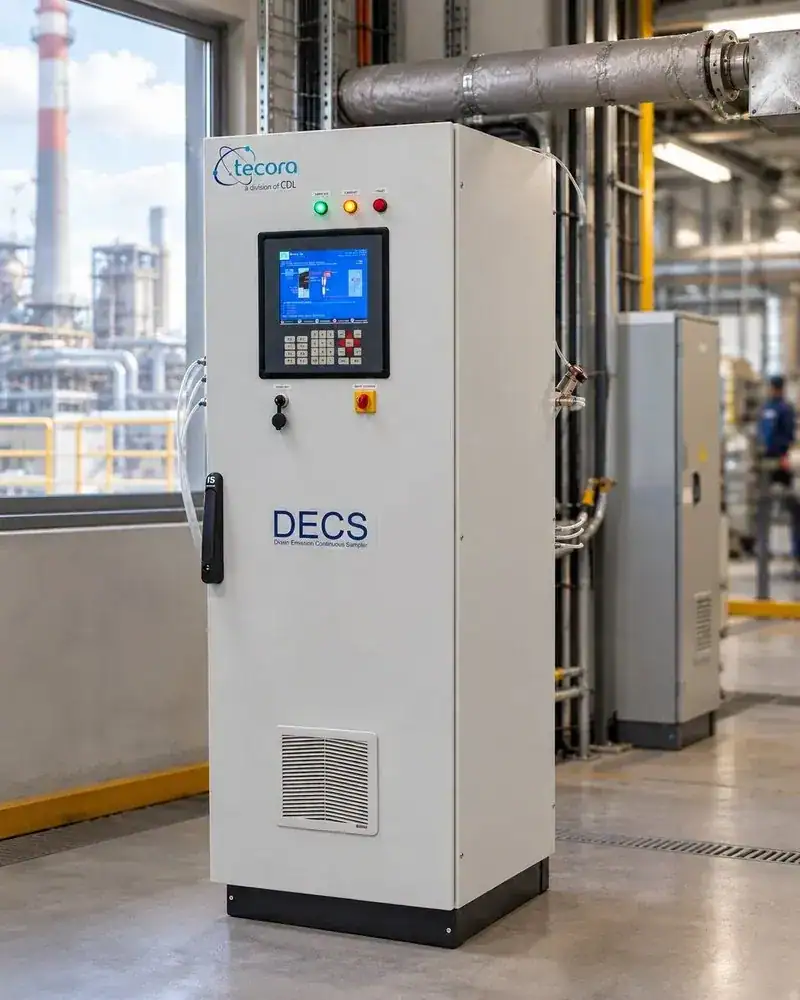
There is currently no harmonised standard for measuring PFAS in air against which compliance can be claimed. The DECS implements a modular sampling architecture (trapping on a solid medium and on an adsorbent cartridge) originally designed for persistent organic pollutants (dioxins, furans, PCBs) in accordance with EN 1948 and USEPA Method 23. This architecture provides a transferable technical basis for building a PFAS-oriented sampling configuration, but any PFAS campaign must be defined and validated with an accredited laboratory according to the applicable method (XP X 43-126 in France), with no claim of PFAS compliance on the part of CDL-Tecora until a standard is finalised.
Preparing a measurement campaign? Our experts can help.
Personalised advice, a fast quote and technical support to choose the right instrument for this standard.