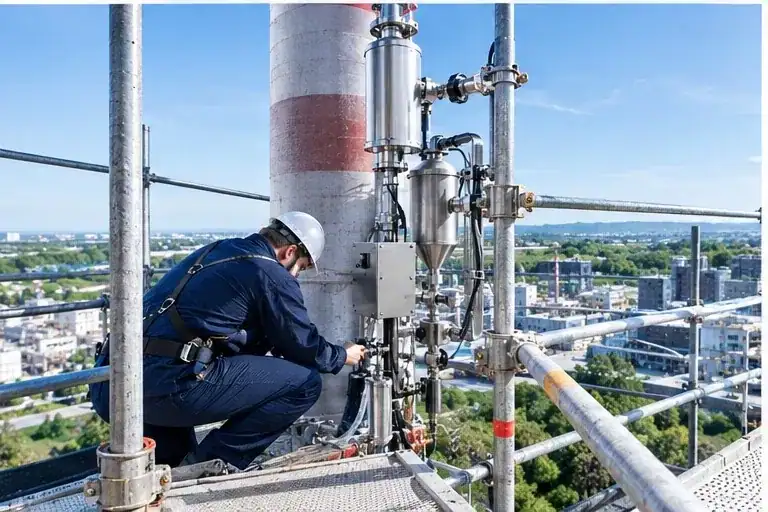
Technician on scaffolding adjusting a dust sampling train on an industrial chimney

International equivalences · Dust & particulates

VDI 2066: Gravimetric Measurement of Dust in Waste Gases

German reference method for the manual and gravimetric determination of dust in industrial gaseous effluents

VDI 2066 (Part 1) is the German reference guideline, published by the VDI (Verein Deutscher Ingenieure), for the manual and gravimetric determination of the concentration and mass flow of dust in a channelled gas stream (stack, industrial duct). It relies on isokinetic sampling of a fraction of the flow, retention of the particles on a filter and then weighing of the mass collected relative to the volume of gas sampled. For its scope of application A (concentrations up to 50 mg/m³), its technical requirements are declared identical to those of the European standard EN 13284-1, which allows a recognised equivalence in regulatory campaigns carried out in Germany.

Key figures

  • VDI 2066 Part 1Standard
  • ≤ 50 mg/m³ (≡ EN 13284-1)Scope A
  • ≤ 150 mg/m³Scope B
VDI 2066 is published by the Verein Deutscher Ingenieure, the German association of engineers: its guidelines (Richtlinien) do not have the formal status of a DIN or EN standard drawn up by an international standardisation committee, but they have long been authoritative in German environmental regulation. Part 1 (Blatt 1), which forms the core of the framework, has existed since 1975 (several decades before the publication of the European standard EN 13284-1 in 2001) and has been revised several times, the version currently in force dating from 2021. 5 fractions at stationary sources by impaction.

Historic German guideline

Published by the VDI since 1975 (Part 1), revised several times, current version dated 2021

Manual gravimetric principle

Isokinetic sampling, filter retention, differential weighing related to the volume of gas sampled

Two scopes of application

Scope A (≤ 50 mg/m³, requirements declared identical to EN 13284-1) and scope B (≤ 150 mg/m³)

Regulatory and technical uses

Limit value checks, calibration of automatic measuring systems, dust collector performance

Technician on scaffolding adjusting a dust sampling train on an industrial chimney
Part 1 nevertheless remains the reference for the general measurement of total dust concentration.

On the ground

Points to watch

Identify the scope of application before the campaign

Scope B (up to 150 mg/m³) falls outside the strict scope of EN 13284-1. Do not confuse the two scopes in a report intended for an authority that explicitly requires EN 13284-1: only scope A benefits from the declared equivalence.

State the equivalence in the measurement report

For an installation subject to German regulations where EN 13284-1 is required, the equivalence of VDI 2066 (scope A) with that standard must be explicitly stated in the report, failing which the result may be challenged by the supervisory authority.

Rigorously respect the isokinetic ratio

As with any manual gravimetric method of this type, a deviation from the isokinetic flow rate over- or under-samples certain particle fractions and invalidates the measurement, regardless of the accuracy of laboratory weighing.

Do not equate equivalence of principle with explicit certification

An isokinetic instrument documented as compliant with EN 13284-1, ISO 9096 or US EPA Method 17 implements the same measurement principle as VDI 2066, but this does not amount to direct certification to the German guideline; the equivalence must be validated by the accredited inspection body for the campaign concerned.

Control weighing conditions in the laboratory

Filter stabilisation in a desiccator, rigorous control of the tare, management of residual moisture: these factors weigh as heavily on the final result as the quality of the isokinetic sampling carried out on site.

Go further

Related standards

Frequently asked

FAQ

Questions about this standard? Here are the most common answers.

Another question?
What exactly does the VDI 2066 guideline measure?

VDI 2066 (Part 1) describes a manual reference method for determining, by gravimetry, the concentration and mass flow of dust in a channelled gas stream (stack, industrial duct). The measurement relies on isokinetic sampling, retention of the particles on a filter, then weighing of the mass collected relative to the volume of gas sampled.

What is the difference between scopes of application A and B of VDI 2066?

Scope A covers gases with dust concentrations up to about 50 mg/m³; for this scope, the technical requirements of VDI 2066 are declared identical to those of EN 13284-1. Scope B covers higher concentrations, up to about 150 mg/m³, a range that falls outside the strict scope of EN 13284-1.

Is VDI 2066 equivalent to EN 13284-1?

For its scope of application A (concentrations up to 50 mg/m³), VDI 2066 is declared technically identical to EN 13284-1, and this equivalence is recognised in the German regulatory framework provided it is explicitly stated in the measurement report. For scope B (higher concentrations), this direct equivalence does not apply in the same way.

Are CDL-Tecora's isokinetic probes VDI 2066 certified?

No, not explicitly. The EN 13284-1 probe and the Instack are documented as compliant with EN 13284-1, ISO 9096 and US EPA Method 17, methods that rely on the same isokinetic gravimetric sampling principle as VDI 2066. None of these products states certified compliance with the German guideline itself; technical equivalence must be validated case by case by the accredited inspection body.

In what context is VDI 2066 used rather than EN 13284-1 directly?

VDI 2066 remains the reference used in practice at installations subject to German environmental regulation (the federal BImSchG Act and its ordinances), where it has been historically established since 1975, well before the adoption of EN 13284-1 in 2001. A measurement carried out under its scope A can be presented as equivalent to EN 13284-1 in a report intended for a European authority, provided this equivalence is explicitly declared.

Does VDI 2066 include other parts besides Part 1?

Yes, VDI 2066 is a family of complementary guidelines. Part 1 covers the general gravimetric method for measuring total dust; other parts deal with more specific aspects, such as Part 10, which describes the measurement of PM10 and PM2.5 fractions at stationary sources by impaction.

Preparing a measurement campaign? Our experts can help.

Personalised advice, a fast quote and technical support to choose the right instrument for this standard.