
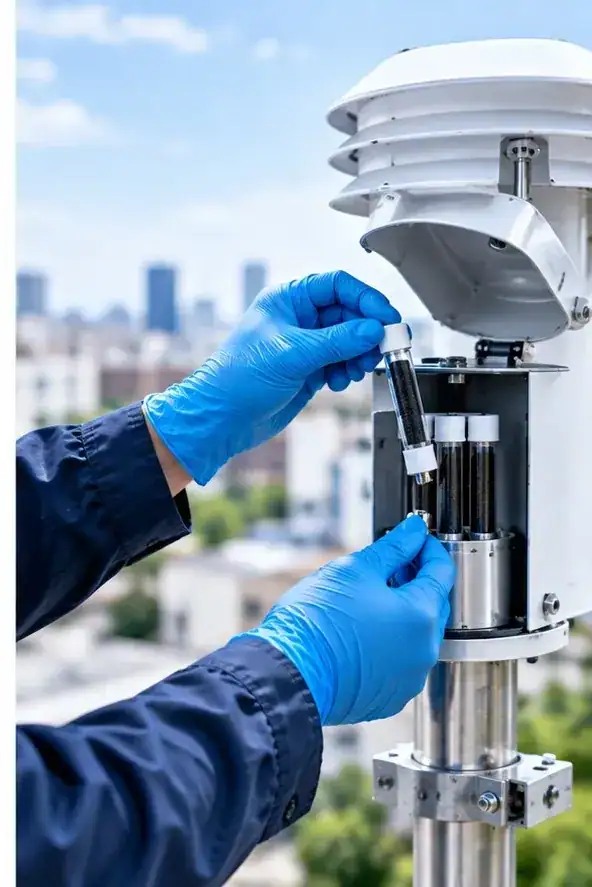
Hands installing an automatic benzene sampling cartridge for ambient air — CDL-Tecora

Ambient air quality

EN 14626: Measurement of Benzene in Ambient Air

Reference method by automatic sampling and gas chromatography for monitoring benzene in ambient air

EN 14626 is the European reference method for measuring the concentration of benzene in ambient air, by automatic pumped sampling onto an adsorbent medium followed by analysis by gas chromatography. It is used by air quality monitoring networks to monitor this volatile organic compound classified as a carcinogen, which comes in particular from road traffic and industrial sources.

Key figures

  • EN 14626Standard
  • Gas chromatographyAnalysis
  • Directive 2008/50/ECRegulatory framework

The sampling principle relies on automatic pumping of ambient air through a tube or cartridge packed with an adsorbent medium (activated carbon or equivalent), which retains the benzene and the other volatile organic compounds present. The sample is then thermally desorbed and injected into a gas chromatograph equipped with a photoionisation detector (PID) or flame ionisation detector (FID), which separates and quantifies the benzene among the other co-adsorbed compounds.

Automatic sampling on an adsorbent medium

Continuous pumping through a tube or cartridge packed with activated carbon or equivalent

Gas chromatography analysis

Thermal desorption followed by separation/quantification with a PID or FID detector

Very low limits of quantification

Suited to the regulatory annual limit value for benzene in ambient air

Reference for monitoring stations

Used to validate the automatic analysers of air quality networks

On the ground

Points to watch

Control the adsorption capacity of the medium

A flow rate or sampling duration that is poorly sized relative to the capacity of the adsorbent medium can cause breakthrough and underestimate the concentration.

Properly separate benzene from co-adsorbed compounds

Chromatographic separation performance is essential so that benzene is not confused with other volatile organic compounds present in ambient air.

Match the analytical sensitivity to the regulatory limit value

As benzene is regulated at very low concentrations, the analysis chain must guarantee a sufficiently low limit of quantification.

Go further

Related standards

Frequently asked

FAQ

Questions about this standard? Here are the most common answers.

Another question?
What does the EN 14626 standard measure?

It determines the concentration of benzene in ambient air, by automatic sampling onto an adsorbent medium followed by analysis by gas chromatography.

Why is benzene specifically monitored?

Benzene is a volatile organic compound classified as a carcinogen, emitted in particular by road traffic and certain industrial sources, which justifies a regulatory limit value in ambient air and a dedicated measurement method.

Which analysis technique is used?

The adsorbed sample is thermally desorbed and then injected into a gas chromatograph equipped with a photoionisation detector (PID) or flame ionisation detector (FID), which separates and quantifies the benzene.

Does this standard apply to channelled industrial emissions?

No, it applies to ambient air monitoring. The monitoring of volatile organic compounds in channelled emissions falls under other references specific to continuous automatic measuring systems (CEMS).

Preparing a measurement campaign? Our experts can help.

Personalised advice, a fast quote and technical support to choose the right instrument for this standard.