
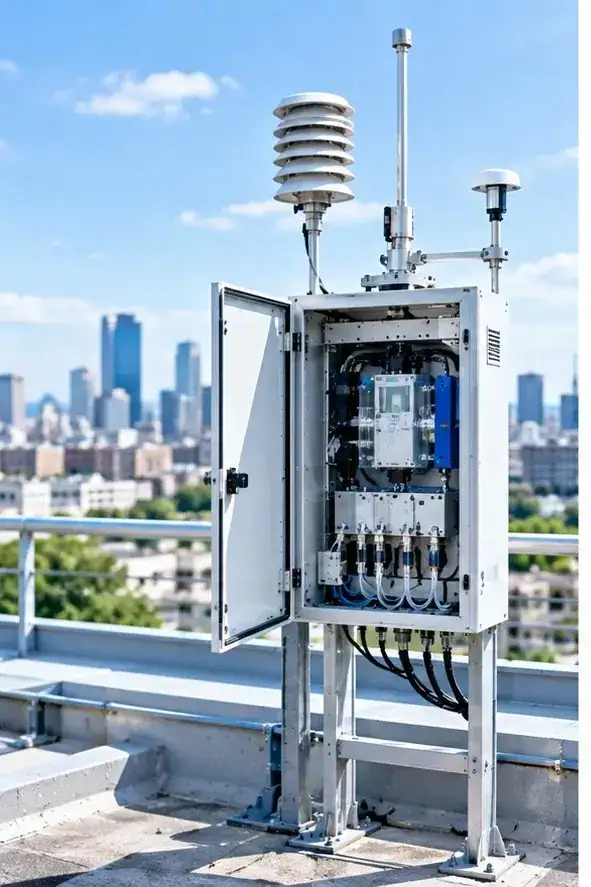
Ambient air quality monitoring cabinet installed on a roof, urban skyline in the background

Ambient air quality

EN 14212: Measurement of Sulphur Dioxide in Ambient Air by UV Fluorescence

Ultraviolet fluorescence reference method for monitoring SO2 in ambient air

EN 14212 is the European reference method for measuring the concentration of sulphur dioxide (SO2) in ambient air by ultraviolet fluorescence. It is used by air quality monitoring networks for the regulatory monitoring of this pollutant, which comes mainly from the combustion of sulphur-containing fuels.

Key figures

  • EN 14212Standard
  • UV fluorescencePrinciple
  • EN 14791 (channelled emissions)Not to be confused with

The measurement principle relies on the excitation of SO2 molecules by ultraviolet radiation at a specific wavelength: the excited molecules then re-emit fluorescent light at a longer wavelength, whose intensity is proportional to the concentration. This direct optical approach contrasts with the reference method for channelled emissions, EN 14791, which relies on wet chemical absorption in hydrogen peroxide: ambient concentrations (in the order of µg/m³) are indeed too low for a time-integrated wet method, and call for a continuous, near real-time optical measurement.

UV fluorescence principle

Excitation of SO2 by ultraviolet radiation, then measurement of the light re-emitted

Continuous, near real-time measurement

Unlike EN 14791 (channelled emissions, delayed wet method)

Hydrocarbon interference management

Dedicated optical filtering to avoid overestimating SO2

Reference for monitoring stations

Used to validate the continuous analysers of air quality networks

On the ground

Points to watch

Check the anti-interference device

The analyser must ensure rejection of aromatic hydrocarbons to avoid overestimating SO2.

Respect the calibration cycles

Periodic zero/span checks and linearity checks specific to optical analysers.

Do not confuse with EN 14791

EN 14791 is the wet reference method for channelled emissions, a different measurement context.

Go further

Related standards

Frequently asked

FAQ

Questions about this standard? Here are the most common answers.

Another question?
What does the EN 14212 standard measure?

It determines the concentration of sulphur dioxide (SO2) in ambient air, using an optical reference method based on ultraviolet fluorescence.

Why not use a wet method as for channelled emissions?

Ambient SO2 concentrations are very low (in the order of µg/m³), too low for an integrated wet method such as EN 14791. A continuous, near real-time optical measurement is better suited to this concentration level.

What interferences can affect this measurement?

Certain aromatic hydrocarbons can also fluoresce under UV excitation and bias the reading towards an overestimation of SO2. Modern analysers incorporate a device to reject this interference.

What is the difference from EN 14791?

EN 14791 measures SO2 in channelled emissions using a wet reference method (hydrogen peroxide). EN 14212 measures SO2 in ambient air using a continuous optical method. The two standards do not apply to the same measurement medium.

Preparing a measurement campaign? Our experts can help.

Personalised advice, a fast quote and technical support to choose the right instrument for this standard.