
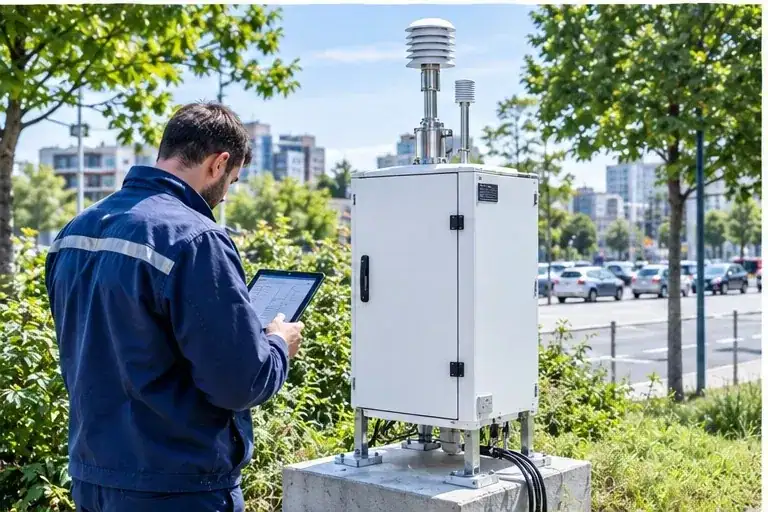
Ambient air quality monitoring station installed outdoors, technician consulting a tablet

Ambient air quality

EN 12341: Gravimetric Measurement of PM10 and PM2.5 Particles in Ambient Air

Gravimetric reference method for monitoring fine PM10 and PM2.5 particles in ambient air

EN 12341 is the European reference method for the gravimetric determination of the concentration of PM10 and PM2.5 particles in ambient air, used by air quality monitoring networks (AASQA in France) for regulatory control and to validate the automatic analysers installed in the field. Unlike the methods used to measure channelled emissions, it applies to outdoor air and not to an industrial duct.

Key figures

  • EN 12341Standard
  • PM10 / PM2,5Fractions
  • Directive 2008/50/ECRegulatory framework

The sampling principle relies on a size-selective inlet head (PM10 or PM2.5 depending on the target fraction), which separates particles by size according to their aerodynamic behaviour, followed by sampling at a controlled flow rate (generally around 2.3 m³/h for low-volume reference samplers, although high-volume samplers also exist) onto a filter over a defined period, typically 24 hours. The filters are conditioned at controlled temperature and humidity before and after exposure, then weighed: the mass difference divided by the volume of air sampled gives the concentration.

Gravimetric filter sampling

Selective PM10 or PM2.5 sampling head, controlled flow rate, weighing before/after conditioning

Reference for automatic analysers

Basis of the European guide to the demonstration of equivalence for continuous monitors

Measures ambient air, not channelled emissions

Applies to outdoor air; not to be confused with EN 13284-1 or ISO 9096 (industrial ducts)

Two distinct fractions

PM10 and PM2.5, each with its own selective sampling head

On the ground

Points to watch

Respect the geometry of the sampling head

Each fraction (PM10 or PM2.5) requires a specific flow rate and aerodynamic separation head.

Condition the filters before and after exposure

Controlled temperature and humidity in the weighing room are essential for a reliable mass.

Do not confuse with channelled-emission methods

EN 12341 applies to ambient air; do not mix it up with EN 13284-1 or ISO 9096, which apply to industrial ducts.

Go further

Related standards

Frequently asked

FAQ

Questions about this standard? Here are the most common answers.

Another question?
What does the EN 12341 standard measure?

It determines the concentration of PM10 and PM2.5 particles in ambient air by gravimetric weighing, from a filter sample taken with a size-selective inlet head.

Does this standard apply to industrial emissions?

No. EN 12341 applies to ambient (outdoor) air quality, as opposed to channelled-emission measurement methods such as EN 13284-1 or ISO 9096, which apply to industrial ducts.

How are automatic particle analysers validated?

Through the European Guide to the Demonstration of Equivalence, which compares the measurements of an automatic analyser (beta gauge, TEOM, optical counter) with gravimetric samples taken in accordance with EN 12341 at the same site.

What is the difference between PM10 and PM2.5?

PM10 refers to particles with an aerodynamic diameter of less than 10 micrometres, PM2.5 to those of less than 2.5 micrometres (a finer fraction). Each fraction is sampled with its own selective inlet head.

Preparing a measurement campaign? Our experts can help.

Personalised advice, a fast quote and technical support to choose the right instrument for this standard.