
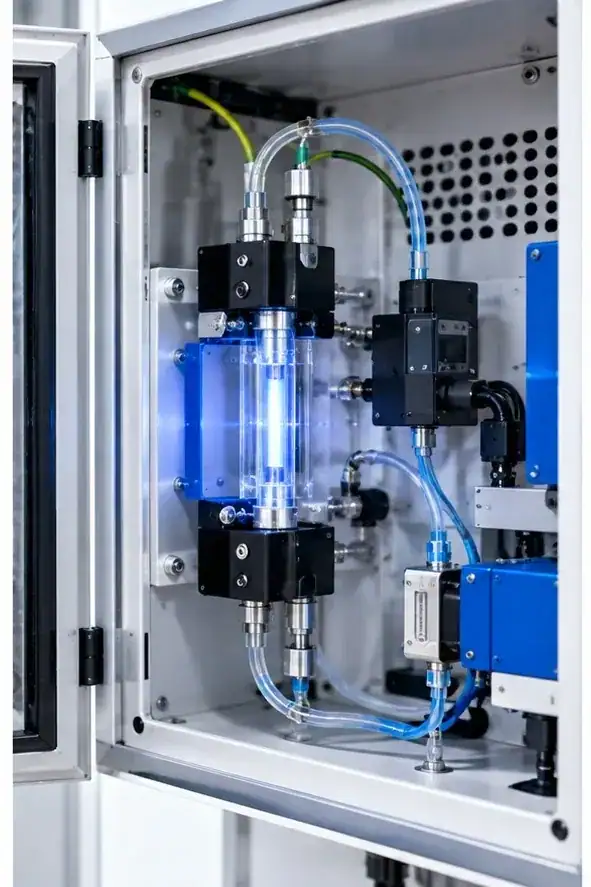
Optical cell of an ozone analyser using ultraviolet photometry — CDL-Tecora

Ambient air quality

EN 14625: Measurement of Ozone in Ambient Air by Ultraviolet Photometry

Ultraviolet photometry reference method for monitoring ozone in ambient air

EN 14625 is the European reference method for measuring the concentration of ozone (O3) in ambient air by ultraviolet photometry. It is used by air quality monitoring networks to monitor this secondary pollutant, formed by a photochemical reaction between nitrogen oxides and volatile organic compounds under the effect of solar radiation.

Key figures

  • EN 14625Standard
  • UV photometry (254 nm)Principle
  • Secondary (photochemical)Nature of the pollutant

The measurement principle relies on the characteristic absorption of ozone at 254 nanometres, the wavelength emitted by a mercury vapour lamp. The analyser compares the light intensity transmitted through a reference cell (ozone removed by a scrubber) and through a cell containing the sample, then derives the concentration directly from this difference in absorption (Beer-Lambert law). It is an absolute physical method, which requires neither a chemical reagent nor a calibration gas beyond a periodic photometric check.

Differential UV absorption principle

Direct measurement according to the Beer-Lambert law, with no consumable chemical reagent

Secondary pollutant

Ozone forms in the atmosphere from NOx and VOCs under solar radiation, with no direct emission to measure at the duct outlet

Absolute method, little drift

The absence of a consumable reagent limits sources of drift over time

Reference for monitoring stations

Used to validate the continuous analysers of air quality networks

On the ground

Points to watch

Periodically check the photometric calibration

Even without a consumable reagent, optical drift of the lamp or cells must be checked periodically.

Position the measurement stations correctly

The photochemical formation of ozone means careful thought must be given to station siting (urban and suburban areas, downwind of precursor sources).

Do not look for an equivalent for channelled emissions

As ozone is a secondary pollutant, there is no comparable duct-outlet measurement method.

Go further

Related standards

Frequently asked

FAQ

Questions about this standard? Here are the most common answers.

Another question?
What does the EN 14625 standard measure?

It determines the concentration of ozone (O3) in ambient air, using a physical reference method based on ultraviolet photometry.

Why is ozone measured only in ambient air and not in channelled emissions?

Ozone is a secondary pollutant: it does not come from a direct emission but forms in the atmosphere from nitrogen oxides and volatile organic compounds under the effect of solar radiation. Only ambient air monitoring therefore makes sense for this pollutant.

Does this method require chemical reagents?

No. It is an absolute physical method based on the UV absorption of ozone (Beer-Lambert law), which consumes no reagent, with only a periodic photometric check required.

How is this method used by monitoring networks?

It serves as the reference to validate and calibrate the automatic ozone analysers deployed continuously by air quality monitoring networks.

Preparing a measurement campaign? Our experts can help.

Personalised advice, a fast quote and technical support to choose the right instrument for this standard.